
Organizational Change in Romania: What current market patterns reveal

What a series of conversations with Romanian leaders reveals about transformation, AI adoption, and why so many initiatives still under-deliver
Most organizations are not struggling to start change. They are struggling to make it stick.
Over the past weeks, I ran a series of conversations with leaders and practitioners working across delivery, HR, L&D, transformation, venture building, and consulting. I also collected written responses through a short form aimed at people involved in change, improvement, and capability-building efforts. The goal was not statistical representation. It was to identify recurring patterns in how change is actually experienced inside organizations and what tends to separate momentum from real progress. What emerged was surprisingly consistent.
The broader Romanian context reinforces the same picture. A recent survey found that 64% of Romanian managers expect major strategic changes in their operating model and digitalization processes, yet only 15% report full alignment between strategy and execution. At the same time, 60% say training investments are being directed toward digitalization, data, and AI, while 48% prioritize management, leadership, and coaching. The pressure to transform is clearly present. The harder question is whether organizations are building the capability required to absorb that pressure productively.

Transformation pressure is rising. Execution quality is not rising at the same pace.
One of the clearest signals across these conversations is that change is no longer exceptional. It is ambient. Organizations are redesigning processes, introducing new tools, integrating structures, experimenting with AI, trying to improve delivery, or reshaping how teams collaborate. In many cases, there is no shortage of strategic intent. There is no shortage of activity either. What is missing is reliable absorption capacity.
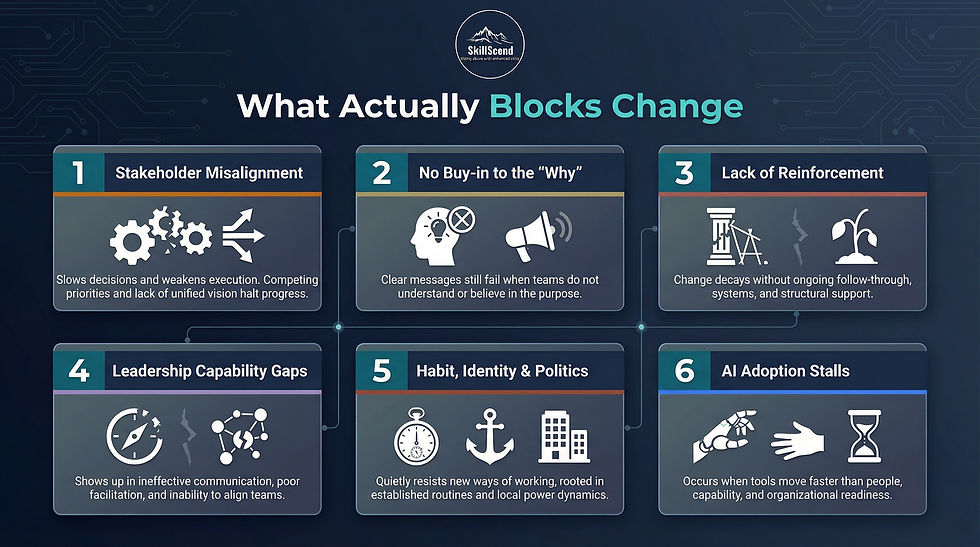
That distinction matters. Many initiatives do not stall because the idea behind them is weak. They stall because the environment they enter is not ready to absorb them. Teams are already overloaded. Managers are stretched. Decision rights are unclear. The “why” is not fully understood. Reinforcement is inconsistent. Under those conditions, even sensible change gets translated into surface compliance, partial adoption, or quiet reversion to old ways of working. The result is an illusion of movement without a corresponding increase in organizational capability.
The biggest blockers are rarely technical. They are structural, behavioral, and relational.
Across both live interviews and form responses, a common pattern appeared again and again: initiatives tend to underdeliver when alignment breaks down across roles, teams, and layers of the organization.
Sometimes that shows up as stakeholder conflict. Sometimes as communication gaps. Sometimes as local politics, unclear ownership, or different parts of the organization working toward different priorities. In several cases, respondents described a familiar scenario: the initiative is launched at a high level, but by the time it reaches operational reality, the details are blurred, the trade-offs are unclear, and the people expected to adopt the change do not fully trust its purpose or practical logic.
This is one reason generic change language so often falls flat. Organizations tend to describe change in terms of frameworks, initiatives, and intentions. People experience it in terms of loss of control, extra effort, conflicting priorities, and ambiguous consequences. The gap between those two realities is where many well-designed initiatives begin to weaken.
Change fails less often at launch than it does in the weeks and months after launch.
A repeated pattern in the conversations was that change is still treated too often as an event. The initiative is announced. A workshop is run. A new process is introduced. Then attention moves elsewhere.
But in practice, change behaves more like a maintenance challenge than a launch challenge. Without follow-through, reinforcement, and visible managerial ownership, people drift back toward familiar habits. Even when they agree intellectually, they do not always adopt behaviorally. In some cases, teams comply in meetings but adapt the process informally to fit old preferences. In others, change decays because no one is actively holding the line between initial intention and everyday execution.
This is where many organizations still underestimate the discipline required for change to become operationally real. Launch energy can create movement. It does not create durability on its own. Durability comes from reinforcement, clarity, feedback loops, and structures that make the new behavior easier to sustain than the old one.
Leadership remains the single biggest leverage point and one of the most common failure points.
If there is one conclusion that cuts across almost every conversation, it is this: leadership behavior plays a disproportionate role in whether change becomes real.
In some organizations, leaders are trying to drive change without the behavioral capability required to do so. They may have authority, but not enough skill in facilitation, alignment, communication, or sense-making. In others, the issue is not lack of intent but lack of coachability: when resistance appears, leaders double down on instruction instead of adapting their approach. In still others, managers are left carrying delivery pressure with too little time, autonomy, or support to help change take root properly.
This pattern aligns with broader market data. According to the Romanian management survey, 82% of managers believe employee loyalty in 2026 will depend primarily on the direct manager and the quality of leadership they provide. That is not just an HR signal. It is an execution signal. When people trust leadership, they are more likely to stay engaged, accept ambiguity, and invest effort into difficult transitions. When they do not, even well-funded initiatives can lose energy quickly.
AI is accelerating the need for change, but it is not removing the human challenge.
AI came up in multiple conversations, but not in the simplistic way the market often frames it. The most useful interpretation is not that AI is replacing the need for transformation. It is intensifying it.
Several respondents described meaningful productivity gains once AI use cases became practical, bounded, and supported. Others described AI adoption as superficial, overhyped, or weakly connected to real business value. In both cases, the same pattern emerged: tools move faster than people. Adoption improves when organizations create safe experimentation, role-specific guidance, and clear standards for how AI should be used. Adoption stalls when rollout is driven by trend pressure, vague messaging, or the assumption that access alone will create value.
The national picture points in the same direction. PwC’s workforce survey shows that only 44% of Romanian employees say they used AI at work in the past year, compared with a 57% global average. Daily use of generative AI is also significantly lower in Romania, at 6%, versus 14% globally. Yet among those who do use AI, the benefits are clear: 75% report improved work quality, 69% higher creativity, and 64% higher productivity. This suggests that the issue is not lack of potential. It is lack of widespread, grounded capability.

The market does not need more abstract transformation language. It needs practical capability infrastructure.
Another important signal from these conversations is that organizations are not necessarily looking for more theory. They are looking for support that helps them see the real picture, align the right people, reduce ambiguity, and build conditions in which change can hold.
The written responses are revealing on this point. When asked what would make external support valuable, respondents pointed to practical guidance, contextual understanding, better cross-functional clarity, and support that reflects the realities of their organization. Even among those who said change is usually handled internally, the unmet needs were similar: better alignment, stronger buy-in, clearer decision-making, and a more reliable path from intention to adoption. Interest in seeing a concrete approach to these challenges was also high among respondents to the form.
That suggests a meaningful market shift. The opportunity is not in offering more generic “change management.” The opportunity is in helping organizations build the capability infrastructure required for change to become real: leadership behavior, alignment mechanisms, reinforcement structures, role clarity, and practical adoption support around new ways of working.
What this says about the Romanian market right now
Taken together, these conversations point to a market under real pressure, but still uneven in how it responds.
Romanian organizations are dealing with operating model shifts, digitalization pressure, efficiency demands, talent retention concerns, and rising AI expectations. But many are still trying to respond with intervention logic that is too shallow for the level of complexity they face. More initiatives. More tools. More communication. More frameworks. Often without enough attention to the conditions that determine whether people can absorb, adopt, and sustain change in practice.
The most consistent pattern behind underdelivery is not lack of ambition. It is a mismatch between the scale of change being asked for and the capability systems available to support it. That mismatch shows up in leadership behavior, stakeholder alignment, decision clarity, reinforcement, and the ability to turn learning into durable shifts in how work actually happens.
Final thought
The market does not appear short on change. It appears short on change that becomes credible, coherent, and sustainable once it meets real organizational conditions.
That is not a pessimistic conclusion. It is a useful one.
Because once the problem is named more precisely, the intervention logic can improve with it. And when intervention logic improves, organizations have a better chance of moving beyond visible activity toward something rarer and much more valuable: real capability.

Comments